

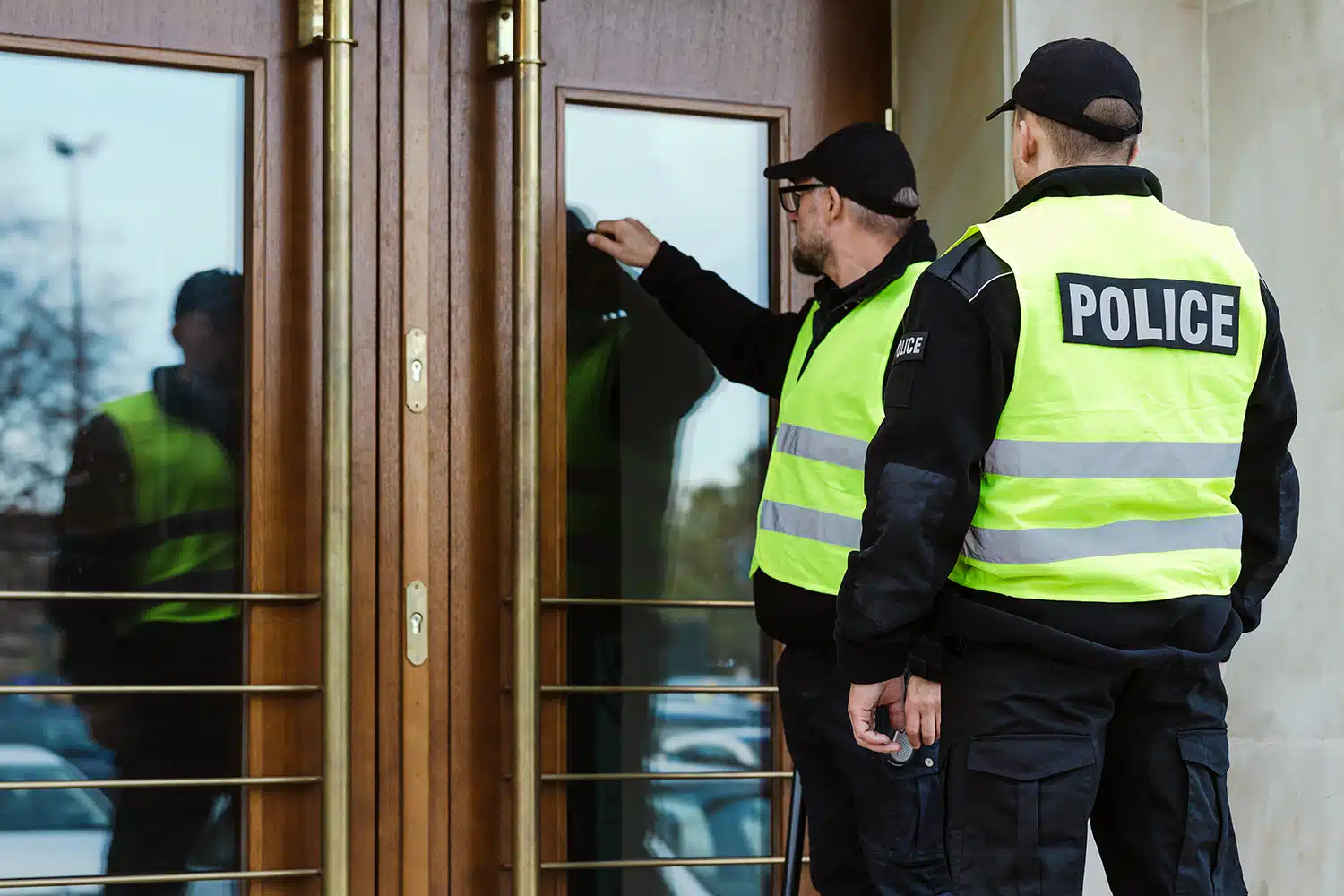
Most people assume that police can’t just walk into your home without a warrant—and in most cases, that’s true. Both the U.S. Constitution and the Tennessee Constitution strongly protect your right to privacy in your own home. But like many areas of law, there are important exceptions.
Whether it’s a knock at the door during a loud party, or a surprise visit after a neighbor’s complaint, understanding when police can enter your home without a warrant in Tennessee is vital for protecting your rights. At Barnes and Fersten, we’ve seen countless cases where the legality of a police entry becomes a central issue—and in some cases, an illegal search can lead to evidence being thrown out entirely.
In this article, we’ll explain when police can and cannot legally enter your home without a warrant in Tennessee, walk through common exceptions, and help you understand what to do if it happens to you.

Search Warrants in Tennessee Explained
Under both the Fourth Amendment to the U.S. Constitution and Article I, Section 7 of the Tennessee Constitution, your home is given the highest level of privacy protection. As a general rule, law enforcement officers must have a valid search warrant issued by a judge before they can legally enter your home.
A search warrant must be based on probable cause and must specifically describe the place to be searched and the items to be seized. This requirement ensures that police officers are not making random or unjustified entries into people’s homes.
Tennessee courts have consistently upheld that warrantless home entries are presumptively unreasonable and the burden is on the State to prove that a recognized exception—such as consent, exigent circumstances, or hot pursuit—justified the entry. Key Tennessee Supreme Court cases supporting this principle include State v. Bartram (1996), State v. Talley (2010), and State v. Stanfield (2018).
Next, we’ll break down the most common exceptions that allow warrantless entry and what those exceptions mean in real-life situations.
1. Consent to Enter
If you or someone with authority over the residence gives voluntary consent, police may legally enter without a warrant.
What You Should Know:
- Consent must be clear and freely given—not the result of intimidation or pressure.
- A roommate or spouse may consent to a shared area, but not all private spaces.
- If one person consents and another objects (and both are present), Tennessee courts generally side with the objector.
Example:
In a Knoxville drug investigation, police may ask to come inside to “just talk.” If you say yes, and they see marijuana or paraphernalia in plain sight, they may seize it and use it as evidence—even without a warrant.
2. Exigent Circumstances
Exigent circumstances exist when police reasonably believe waiting for a warrant would risk harm, escape, or destruction of evidence.
Typical Situations Include:
- Reports of domestic violence or ongoing physical danger
- Suspected destruction of drugs, alcohol, or other evidence
- Emergency medical calls
Example:
Officers responding to a domestic violence call hear screams inside the home. They may lawfully enter without a warrant to prevent harm.
3. Hot Pursuit of a Suspect
If a suspect flees from police and runs into a residence, officers may enter under the hot pursuit exception.
Important Clarifications:
- Hot pursuit usually applies to felony charges, like felony DUI, assault, or theft.
- The chase must be active and continuous.
- Officers can’t create a “pursuit” just to avoid getting a warrant.
Example:
A driver suspected of a felony DUI in Knoxville refuses to stop, parks at home, and runs inside. Officers may follow and enter without a warrant.
4. Plain View Doctrine (While Lawfully Inside)
The plain view doctrine allows police to seize evidence without a warrant—but only if they’re already inside the home lawfully.
Key Rules:
- The officer must be where they’re allowed to be.
- The object’s incriminating nature must be immediately obvious.
- Police cannot move items or enter just to find something in plain view.
Example:
Officers respond to a welfare check and enter legally. If they see baggies of pills on the kitchen table, that could be seized under plain view and used in a Knoxville drug possession case.
5. Search Incident to Arrest
If police arrest someone in or near their home, they may conduct a limited search of the area within the suspect’s reach.
What This Means:
- This exception does not allow police to search the whole house.
- It only covers areas where the person could access weapons or destroy evidence.
Example:
A suspect is arrested at the front door for a domestic assault warrant. Police may search nearby furniture or bags, but not other rooms or locked containers.
6. Probation or Parole Conditions
People on probation or parole often have reduced Fourth Amendment rights as part of their supervision terms.
What to Watch For:
- If you’re on probation for a DUI or drug offense, your supervision terms may allow random home checks.
- However, searches must still be reasonable and not pretextual.
Example:
Someone on probation for a felony drug conviction may be subject to a probation search—but only within the limits of their signed agreement.
How Our Criminal Defense Attorneys Approach Warrantless Entry Cases
When the police enter a home without a warrant, everything that happens afterward can hang in the balance. But challenging an illegal entry is only one piece of an effective criminal defense. Our approach is built on the understanding that every case requires a defense strategy that is thorough, methodical, and tailored to the individual client.
We Start With the Entry—Then Examine the Entire Case
In a case involving a warrantless entry, our defense attorneys fully scrutinize the legality of the matter under the Fourth Amendment and the Tennessee Constitution. But we also go far beyond the front door.
Our attorneys evaluate:
- How the officers justified entering your home
- How they conducted themselves once inside
- Whether the evidence actually proves the charges
- Whether statements were coerced or taken improperly
- Whether the State can establish possession, impairment, or intent
- Opportunities for reduction, dismissal, or diversion
A warrantless entry may open the door to suppression—but our criminal defense lawyers examine every angle to strengthen your defense.
We Know How East Tennessee Judges View These Cases
Warrantless entry cases can be interpreted differently depending on the county, judge, and prosecutor. Our firm appears regularly in courts across Knox County, Blount County, Anderson County, Sevier County, and throughout East Tennessee, giving us insight into:
- Which judges take a strict view of exigent circumstances
- How local courts evaluate claims of “consent”
- What prosecutors need to see before considering dismissal
- When a suppression motion is likely to succeed—or when another strategy is better
This local insight allows us to tailor your defense to the specific courtroom and legal culture you’re up against.
Our Defense Approach Is Proactive, Not Reactive
We don’t sit back and wait for the State to make its next move. Our legal team proactively builds a strong, aggressive defense for your case, including:
- Pulling bodycam and dashcam immediately
- Analyzing dispatch logs and radio traffic
- Reviewing sworn statements for inconsistencies
- Challenging assumptions officers made about odors, behavior, or “furtive movements”
- Investigating whether officers exceeded the scope of any exception claimed
- Looking for leverage that improves your outcome long before trial
Our goal is to undermine the prosecution’s case at every point, not just where the entry occurred.
Talk to a Knoxville Criminal Defense Lawyer Today
If police have entered your home without a warrant, you shouldn’t assume what they did was legal—or that the evidence they gathered can’t be challenged. At Barnes and Fersten, our criminal defense and DUI attorneys know how Tennessee courts evaluate these situations and when a bad entry can lead to suppressed evidence, reduced charges, or even a dismissal.
Contact Barnes and Fersten today by calling 865-805-5703 or filling out our contact form to schedule a free, confidential consultation. We’ll review how the entry happened, explain your rights under Tennessee law, and build a tailored defense strategy designed to protect your future and peace of mind.

Attorney At Law, Managing Partner
Brandon D. Fersten is an esteemed Knoxville attorney practicing DUI, criminal defense, and juvenile law. Known for his empathetic approach and commitment to his clients, he brings a record of favorable case outcomes including dismissals and not guilty verdicts at jury trials resulting in Brandon being recognized as one of the “Top 40 Under 40” in Criminal Defense, U.S. News’ Best Lawyers: “Ones to Watch,” and Super Lawyers’ “Rising Stars”. Brandon’s professional accolades, combined with his passion for justice, position him as a reliable criminal defense advocate in the East Tennessee legal landscape, including Knox County, Blount County, Sevier County, Loudon County, Roane County, Anderson County, Cumberland County, Hamblen County, Monroe County, and McMinn County.
